Baton Rouge Dentist

Ryan P. Perry, DDS
  • Home
  • About Us
    • About Our Office
    • Meet Dr. Perry
    • Request an Appointment
    • Office Hours
    • Map and Directions
    • Financial Policies
    • Free Initial Exam
  • Payment
  • Cosmetic Dentistry
    • Porcelain Veneers
    • Porcelain Crowns
    • Teeth Whitening
    • Dental Bonding
    • CEREC Crowns
    • White Fillings
  • ^
  • General Dentistry
    • Gum Disease
    • Root Canal Treatment
    • TMJ Dentist
    • Mercury Free Dentist
    • Gentle Dentistry
    • Emergency Dentist
    • Sedation Dentist
    • Pediatric Dentistry
    • Sleep Apnea
  • Reconstructive Services
    • Dental Implants
    • Dental Implants Cost
    • Affordable Dental Implants
    • Dental Bridges
    • Dental Bridge vs Implant
    • Dentures

Archives for June 2026

What Are My Treatment Options for Enamel Hypoplasia?

Posted on June 30, 2026 by AllSmiles.

I have two scheduled consultations for enamel hypoplasia. Although I was diagnosed with this condition three years ago, this summer is my first opportunity to address it. What treatment options might a dentist offer to conceal the white spots on my teeth? Thanks. Amir from IL


Amir,

Enamel hypoplasia occurs when tooth enamel does not develop properly. The condition can result from genetic factors or health issues that occur during tooth development.

Because enamel is the tooth’s protective outer layer, incomplete development can leave teeth vulnerable to discoloration, rough surfaces, and uneven texture.

How Does Enamel Hypoplasia Look?

The condition can range from very mild to quite severe.

Common signs include:

  • White spots on the enamel
  • Yellow or brown discoloration
  • Small pits or grooves
  • Thin enamel
  • Areas where the underlying dentin becomes visible

Some patients have only one affected tooth, while others have multiple teeth involved.

What Is the Treatment for Enamel Hypoplasia?

Treatment for enamel hypoplasia depends on the severity of the case. Mild cases may improve with dental bonding. Severe cases may require porcelain veneers or full crowns if significant tooth structure is missing.

Mild enamel hypoplasia treatment

When enamel hypoplasia is limited to small white spots or minor surface defects, conservative treatment is often the best approach.

Composite bonding can often improve the appearance of spots on teeth without removing significant tooth structure. The bonding material is shaped and polished to blend with the surrounding enamel.

If the spots are minor and do not bother you, monitoring them may also be a reasonable option.

Several enamel hypoplasia treatment
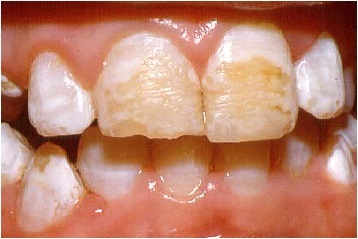
Damaged tooth enamel with white spots and brown vertical streaks from severe enamel hypoplasia
Severe enamel hypoplasia

Severe enamel hypoplasia typically requires a more comprehensive solution. When enamel is extensively damaged, simply covering small areas with bonding may not provide a lasting or esthetic result.

Depending on the condition of the teeth, treatment may include:

  • Porcelain veneers for visible front surfaces
  • Full dental crownsv when enamel loss affects a larger portion of the tooth
  • Restorative treatment for multiple teeth when several teeth are involved

The objective is to strengthen the teeth while improving their appearance.

How to Choose a Dentist for Enamel Hypoplasia

Enamel hypoplasia can be challenging to restore because natural enamel has depth, translucency, and color variation. Reproducing those characteristics requires both quality materials and experience.

Whether treatment involves bonding, veneers, or crowns, careful planning helps achieve a result that looks natural and functions well for years to come.

Baton Rouge family dentist Dr. Ryan Perry sponsors this post. Read why his patients say he is the best dentist in Baton Rouge.
Filed Under: Tooth stains Tagged With: enamel hyoplasia, enamel hypoplasia treatment, tooth defects, tooth discoloration, tooth enamel spots, tooth spots, white spots on teeth

Will Antibiotics Work Instead of a Repeat Root Canal?

Posted on June 14, 2026 by AllSmiles.

My dentist wants to do a repeat root canal on an upper first molar, and I want to know if it’s necessary. The temporary filling fell out a couple of weeks after my dentist completed the root canal. My dentist says I now have an abscess in the gum around the tooth, so she wants to repeat the root canal. However, the tooth doesn’t hurt at all. Is this necessary treatment, or are antibiotics enough? – Thanks. Japheth from WY

Japheth,

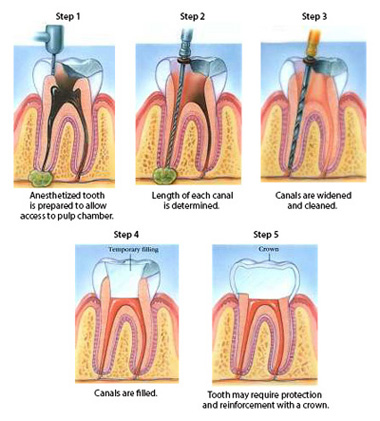
During a root canal, your dentist removes the infection inside the tooth and seals the root with a filling material and cement. That seal must stay protected, or bacteria can re-enter the tooth and restart the infection. A temporary filling protects the tooth until you get a crown or a permanent filling.

Root canal emergency diagram of five procedure steps
Root canal therapy

Temporary fillings are intentionally easy to remove because they will be replaced with a final restoration. If a temporary filling falls out, saliva can seep into the tooth within days, breaking down the root canal seal. Once that happens, the infection can return, although it may be painless.

Will Antibiotics Be Enough to Treat a Tooth Abscess?

Antibiotics cannot reach the source of the infection inside the tooth.

Here’s why they cannot heal an abscess:

  • Antibiotics travel through the bloodstream, but there is no blood supply inside a tooth.
  • They may temporarily reduce swelling or an abscess in the surrounding bone or gum.
  • Once you stop taking them, the infection typically returns.

Repeated antibiotic use also increases the risk of antibiotic-resistant bacteria, which creates unnecessary health risks.

Why It’s Risky to Delay a Repeat Root Canal

Even if the tooth doesn’t hurt, an untreated infection can spread. Infections in the jawbone—especially in the upper jaw—can extend to nearby structures, including the sinus, eye, or brain. In addition, bacteria left inside the tooth allow decay to progress from the inside out, eventually making the tooth impossible to restore.

Baton Rouge family dentist Dr. Ryan Perry sponsors this post. Please read about how he strives to provide his patients with the best care possible.

Filed Under: Root Canal Treatment Tagged With: antibiotics tooth infection, repeat root canal, root canal, tooth abscess, tooth abscess antibiotics

Phone number: 225-275-5910
9094 Jefferson Hwy
Baton Rouge, LA 70809
Ryan P. Perry, DDS
Phone: 225-275-5910
Ryan P. Perry, DDS
9094 Jefferson Hwy Baton Rouge, LA 70809
Google Reviews Yelp Reviews
  • Best Baton Rouge Dentist
  • Baton Rouge Affordable Dentist
  • Privacy Policy
  • Blog

©2009-2026 Ryan P. Perry, DDS • All rights reserved
Website Design and SEO by Infinity Dental Web IDW Copyright Logo

  • Home
  • About Us
    • About Our Office
    • Meet Dr. Perry
    • Request an Appointment
    • Office Hours
    • Map and Directions
    • Financial Policies
    • Free Initial Exam
  • Payment
  • Cosmetic Dentistry
    • Porcelain Veneers
    • Porcelain Crowns
    • Teeth Whitening
    • Dental Bonding
    • CEREC Crowns
    • White Fillings
  • ^
  • General Dentistry
    • Gum Disease
    • Root Canal Treatment
    • TMJ Dentist
    • Mercury Free Dentist
    • Gentle Dentistry
    • Emergency Dentist
    • Sedation Dentist
    • Pediatric Dentistry
    • Sleep Apnea
  • Reconstructive Services
    • Dental Implants
    • Dental Implants Cost
    • Affordable Dental Implants
    • Dental Bridges
    • Dental Bridge vs Implant
    • Dentures
  • Click to Call
    (225) 275-5910