Baton Rouge Dentist

Ryan P. Perry, DDS
  • Home
  • About Us
    • About Our Office
    • Meet Dr. Perry
    • Request an Appointment
    • Office Hours
    • Map and Directions
    • Financial Policies
    • Free Initial Exam
  • Payment
  • Cosmetic Dentistry
    • Porcelain Veneers
    • Porcelain Crowns
    • Teeth Whitening
    • Dental Bonding
    • CEREC Crowns
    • White Fillings
  • ^
  • General Dentistry
    • Gum Disease
    • Root Canal Treatment
    • TMJ Dentist
    • Mercury Free Dentist
    • Gentle Dentistry
    • Emergency Dentist
    • Sedation Dentist
    • Pediatric Dentistry
    • Sleep Apnea
  • Reconstructive Services
    • Dental Implants
    • Dental Implants Cost
    • Affordable Dental Implants
    • Dental Bridges
    • Dental Bridge vs Implant
    • Dentures

Is a Repeat Root Canal Worth It?

Posted on April 15, 2026 by AllSmiles.

My dentist wants to repeat a root canal on one of my upper right molars. The last root canal was in 2019. Is it worth it, or will the tooth weaken and break? Thanks. Jovana from Brooklyn

Jovana,

You can repeat a root canal more than once. However, each attempt should be based on its chance of success.

Why Do Root Canal Outcomes Vary?

Inside every tooth is a pulp chamber and a network of canals that carry nerves and blood supply. When infection develops, this space must be thoroughly cleaned and sealed.

The difficulty is that this internal system is often complex and unpredictable. Some teeth have extra canals or tiny branches that are hard to access.

This complexity explains why outcomes can vary:

  • Most root canals succeed
  • A small percentage fail even when done properly
  • Complex anatomy increases the risk of failure

How Effective Is Root Canal Retreatment?

If a root canal doesn’t heal as expected, retreatment may help. However, the success rate is lower than that of the original procedure.

  • Retreatment succeeds in about 50–75% of cases
  • Results depend on how much of the infection can be accessed and removed
  • Multiple attempts usually have reduced effectiveness

If a highly skilled provider has already tried retreatment, repeating it again may not be the most effective approach.

Alternatives to Repeat Root Canal Therapy

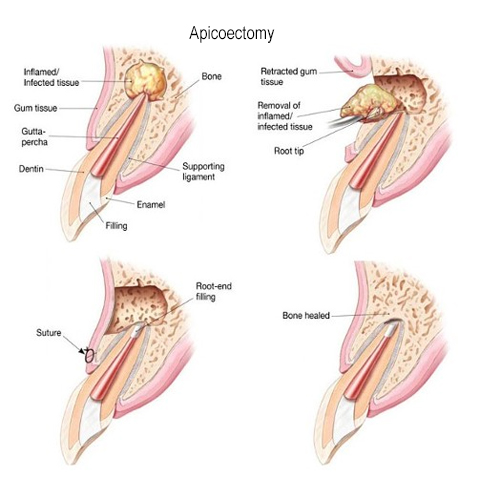
Diagram of an apicoectomy procedure
Apicoectomy accesses the tooth from its root tip

When retreatment is not ideal, your dentist may recommend a different strategy. These options focus on addressing infection from another angle.

  • Apicoectomy with retrofill:
    A specialist removes the root tip and seals it from the end. This approach can reach areas that standard root canal instruments cannot.
  • When surgery isn’t appropriate:
    Some teeth, especially in the lower jaw, sit close to important nerves. In these cases, surgery may carry a higher risk.
  • Extraction:
    If the tooth cannot be predictably saved, removal may be the most practical option.

A careful evaluation, including imaging and possibly a second opinion, can help you understand your options and treatment for the best long-term outcome.

Baton Rouge dentist Dr. Ryan Perry sponsors this post. Read why many patients say he is one of the best dentists in Baton Rouge

Filed Under: Root Canal Treatment Tagged With: repeat root canal, root canal, root canal or extraction, root canal vs apicoectomy

Could I Really Have a Cavity with No Signs or Symptoms?

Posted on January 23, 2026 by AllSmiles.

The outside of my tooth looks fine. Even my dentist admitted it has no outward signs of wear, cracks, damage, or anything else. However, my dentist referred me to an endodontist for a root canal. The tooth doesn’t hurt, but my dentist said I have a cavity on the inside. I can’t read tooth X-rays, so I couldn’t challenge her findings? Should I see the endodontist anyway? I must mention that my dentist has a hyphenated name, and the endodontist’s last name is the same as the first half of my dentist’s last name. I am suspicious. Thanks. Phil from OH

Phil,

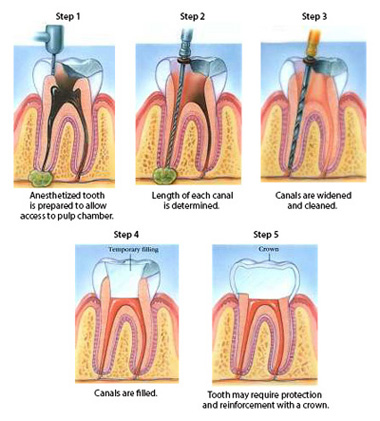
Root canal emergency diagram of five procedure steps
Root canal therapy

We understand the concern about your referral for a tooth with no signs of decay. Also, since your dentist and the endodontist share part of your dentist’s name, you have additional concerns.

Can Tooth Decay Start Within a Tooth?

A tooth cannot develop decay internally without bacteria entering from the outside. Cavities always start on the surface. When they progress deep enough, infection follows and may require root canal treatment.

If imaging suggests damage beginning inside the tooth, the issue likely isn’t decay.

What Is Internal Resorption?

Internal resorption occurs when the pulp begins to erode the tooth from within. This inflammatory process is rare and not fully understood. Dentists believe some form of irritation must trigger it.

Trauma may contribute, particularly if a tooth is subjected to additional force due to its position. Still, because this diagnosis is uncommon, it deserves careful verification.

Why Get a Second Opinion?

Given the uncertainty, a second opinion from an endodontist offers the safest path forward. That approach allows for an unbiased evaluation before committing to treatment.

To keep the opinion objective:

  • Bring copies of your X-rays.
  • Don’t mention previous diagnoses or providers.
  • Let the specialist assess the case independently.

Another Condition to Consider

External root resorption affects the outside of the tooth and can mimic internal resorption on X-rays. Taking multiple images at different angles often clarifies which condition is present and guides appropriate treatment.

Baton Rouge family dentist Dr. Ryan Perry sponsors this post. Please read about how he strives to provide his patients with the best care possible.
 

Filed Under: Root Canal Treatment Tagged With: root canal, root canal referral, root canal second opinion, tooth cavity, tooth cavity no signs, tooth cavity no symptoms

Is Treatment for a Gum Cyst Necessary?

Posted on April 22, 2025 by AllSmiles.

My dentist said the tender bump on my gum above my first molar is a chronic, benign abscess. I’m concerned the lump doesn’t hurt, so my dentist referred me to an endodontist. The endodontist wants to perform a root canal for a cyst or abscess. Is that necessary, or is this exploratory surgery? Am I increasing the risk of damaging my tooth and needing it whittled down for a crown? Thanks, Layla from Seattle

Layla,

It’s understandable to feel concerned about the lump in your gums, particularly when receiving unclear information from your dental providers. We want to acknowledge your concerns and provide clear information to help you navigate this situation.

Clarifying the Likely Issue and Treatment Path

Root canal emergency diagram of five procedure steps
Root canal therapy

Finding a lump on your gums causes worry. While a cyst is possible, it’s statistically less common in the gums than an infection stemming from a tooth’s nerve. An endodontist specializes in treating these issues, and the standard, highly effective approach is root canal therapy. This treatment focuses on cleaning the infection from within the tooth to save it. An apicoectomy (root canal treatment from the root tip) is generally considered a secondary measure, used primarily if unique circumstances prevent a successful outcome with standard root canal treatment alone.

Why Timely Treatment Matters for Your Well-Being

Addressing a dental infection, especially one that has been present for two years, is crucial for oral and overall health. Your body actively fights infection, which can be draining over time. Taking steps to resolve the infection is essential for several reasons:

  • Your body will no longer need to constantly fight the infection, which may increase your energy levels.
  • Removing the infection protects your jawbone and surrounding teeth from potential damage or spread.
  • Treating the source eliminates the risk of bacteria entering your bloodstream.

Root canal treatments performed by specialists boast a success rate of 85% or higher, often enhanced by modern technology. If, in a rare case, the root canal doesn’t fully resolve the problem, an apicoectomy could be considered down the line. Feeling unsure is perfectly normal, and you can seek a third opinion from another endodontist’s office for reassurance and clarity. By planning your care proactively, you can manage the situation effectively and avoid the need for urgent dental treatment.

Baton Rouge family dentist Dr. Ryan Perry sponsors this post. Please read about how he strives to provide his patients with the best care possible.

Filed Under: Root Canal Treatment Tagged With: apicoectomy, gum abscess, gum cyst, root canal, root canal abcess, root canal cyst

Why Can’t I Get a Root Canal Instead of an Extraction?

Posted on March 15, 2025 by AllSmiles.

Half my tooth broke off in a crown I got 20 years ago. My dentist said the tooth was infected, and there was a pus sac at the base of the tooth. My dentist says he needs to extract the tooth. Why won’t root canal treatment work? – Thanks. Tyree from GA


Tyree,

Your dentist may be correct, but some dentists are eager to extract teeth unnecessarily. Your dentist should have explained why root canal treatment wouldn’t work. So, you can ask or dentist or get a second opinion from another dentist to see if the tooth is savable.

When Might Tooth Extraction Be Necessary?

Tooth extraction may be necessary when the tooth is so decayed that insufficient structure is left to restore it. Perhaps a tooth has been missing for so long that the teeth on either side have drifted into the space, and there isn’t room to restore the tooth.

Saving and restoring teeth is hard work; sometimes, a dentist may fail. Look for a dentist with experience in root canal treatment or find an endodontist (root canal specialist) to determine whether your tooth is savable and what treatment is required to do it. Otherwise, you may get a recommendation for an extraction and dental implant.

Baton Rouge family dentist Dr. Ryan Perry sponsors this post. Read how he strives to provide some of the best dentistry in Baton Rouge.

Filed Under: Root Canal Treatment Tagged With: failed root canal, root canal, root canal vs extraction, tooth extraction

Why Am I Having a Tooth Flare-Up Five Years After a Root Canal?

Posted on November 15, 2024 by AllSmiles.

Six years ago, my dentist performed a root canal procedure on my upper left first molar. The procedure went fine, and the tooth felt comfortable until late September. I hadn’t eaten anything unusual but noticed a dull toothache. Now, the tooth hurts daily, and the pain is getting worse. My dental appointment isn’t until two weeks after the Thanksgiving holiday when I return from vacation. Is a tooth savable if I’ve already had a root canal? – Thanks. Kaitlynn from IN


Kaitlynn,

Root canal failure occurs in 10% of teeth treated. Failure occurs when the tooth doesn’t fully heal and eventually flares up, as is the case for your situation.

Why Might a Tooth Flare Up Years After a Root Canal?

Root canal emergency diagram of five procedure steps
Lingering infected tissue can cause irritation months or years after a root canal

A tooth might become irritated years later if some infected tissue lingers after a root canal. Due to the intricate anatomy of teeth, particularly those with curved or branching roots, removing all infected tissue during a root canal procedure can be challenging. Any residual infection can lead to future complications.

Either root canal retreatment or surgery may be necessary to address root canal failure. A dentist may refer you to an endodontist (specialist in root canal therapy) for retreatment. The goal is to identify and eliminate the source of the persistent infection. While the success rate of retreatment or surgery is often estimated at 50%, the outcomes are usually more favorable.

It’s also possible that the tooth has developed a crack, which could contribute to the ongoing issues. Unfortunately, the prognosis for saving a tooth with a crack is generally poor. If the tooth is unsavable, your dentist will explain tooth replacement options.

Baton Rouge family dentist Dr. Ryan Perry sponsors this post. Please read about how he strives to provide his patients with the best care possible.

Filed Under: Root Canal Treatment Tagged With: dentist or endodontist root canal, repeat root canal, root canal, root canal second opinon, tooth hurts after root canal, tooth hurts years after root canal

Is a Root Canal Worth It?

Posted on August 18, 2024 by AllSmiles.

Is a root canal worth it? My bottom right first molar will either need a root canal or extraction and dental implant. My second molar is missing. If I decide to have the dentist extract my tooth, could a snap-on smile help? – Thanks. Wendy from VA

Wendy,

You mentioned that you’ve already lost your second molar and are deciding whether to extract your first molar or get a root canal treatment. Without molars on your left side, you would be unable to chew and function properly.

Is a Root Canal Worth It?

When a natural tooth is savable, the best option is a root canal treatment followed by a crown. Root canal treatment is less expensive than a dental implant, but some prefer dental implants for long-term stability and predictability.

Given the benefits of preserving your natural tooth and the potential complications of losing it, a root canal treatment followed by a crown seems to be the most practical and cost-effective solution in your case. However, schedule an exam with an experienced dentist to determine the pros and cons of your treatment options.

Is a Snap-On Smile a Reliable Tooth Replacement Option?

While a snap-on smile can temporarily solve social situations, understand its limitations. It’s a cosmetic option, not for long-term use or heavy chewing. If you wear the appliance regularly, you need to replace it frequently.

What Are Alternatives to a Snap-On Smile?

A removable partial denture is an alternative to a snap-on smile for replacing missing teeth. However, its stability and effectiveness depend on having teeth in the back to anchor it.

Imagine a table with only two legs on one side. Similarly, your bite is unbalanced when you try to replace molar teeth with a denture supported only by front teeth. The force on the front teeth can cause them to tilt and eventually loosen.


Baton Rouge family dentist Dr. Ryan Perry sponsors this post.  Read how Dr. Perry strives to provide some of the best dental care in Baton Rouge.

Filed Under: Root Canal Treatment Tagged With: root canal, root canal benefits, root canal pros and cons, root canal vs implant, root canal worth it, snap-on smile

Are CEREC crowns cheap because they are quick?

Posted on March 26, 2018 by Travis Wachendorf.

I am suffering from a toothache that is similar to one I had about a year ago. To fix it then, I ended up getting a root canal and a crown. The process took three appointments: one for the actual root canal, one to go back and get my crown, and one more to make an adjustment on the crown. I’m pretty sure that I may end up getting a root canal and crown again. I have noticed signs for “Crowns in a day.” One appointment instead of three sounds great. I’m worried, though, that it’s going to be a cheap crown that won’t last. Usually, if it sounds too good to be true, it is. Should I avoid these quick-crown dentists?

Shelby, Richardson, TX

Dear Shelby,

It’s natural to question the value of something done quickly. In many instances, “fast” does cause you to consider quality. For example, if your home is built too quickly, you may question whether the builders did their best work.

How are CEREC crowns made so quickly?

In the case of the “Crowns in a day,” or CEREC crowns, the quality isn’t questioned because it is done quickly. The reason they are able to do it in a day is that they mill the crown in their office. Using computer programs, the dentist is able to match the colors and the shape of your tooth and to make the crown while you are in his chair.

When the dentist is finished with your root canal, the crown can be fitted and you go home with it. By having a CEREC machine in the office, it cuts out the steps of sending off your crown specs to a different ceramist to create it and waiting for it to come back to the dentist to place over your tooth.

With that said, the quality of CEREC crowns isn’t undermined by the time spent to create them, but possibly by the dentist behind it. Any dentist can have a crown-making machine in their office. That doesn’t automatically mean they are a master at using it. It takes training and experience to be able to create a crown that is going to match with your other teeth in shape and color and look as natural as possible. So before just going to any CEREC crown dentist, do your homework. Go to the dentist’s office and look at examples their work so you can get the best results possible.

This post is sponsored by Dr. Ryan Perry in Baton Rouge, LA.

Filed Under: CEREC Crowns, Root Canal Treatment Tagged With: ceramic crown, cerec crowns, cerec dentist, crown in a day, one day crown, quick crown, root canal

Will it ruin a new crown to grind down a high spot?

Posted on November 26, 2017 by writeradmin.

I recently had a root canal and got a crown on a molar on the bottom and now my bite is off. It doesn’t feel like it used to. My teeth don’t fit together the same when I bite or clench my jaw. I think it needs to be ground down or something, but my dentist thinks I’ll get used to it and I just have to give it time. Will it ruin my crown if the dentist grinds it down? Is that why my dentist doesn’t want to fix it?

Kay, Denver, Colorado

Dear Kay,

That’s too bad that your dentist is asking you to be patient instead of trying to adjust your dental crown. Unfortunately, when dentists do that, it is often a sign that they aren’t comfortable or knowledgeable about the correction.

The way your upper and lower teeth meet when you chew, and how your teeth function together, is called occlusion. When you get a crown, the shape of the crown is similar to, but most likely not exactly like, the contour of the original tooth, and the occlusion may be different. Over time, you may get used to your new bite, but in some instances, when the bite is off, it can cause unusual stress on the teeth. This stress can lead to bone loss or contribute to TMJ disorders.

When a new crown feels off, most dentists will simply fix it so it isn’t so high. There is a special “registration paper” that the dentist would ask you to tap and bite your teeth together on. When there is a part of the tooth that hits before the rest of the tooth, the dentist will grind the tooth in that spot to fix it. It doesn’t hurt the crown to grind down small spots that may be causing discomfort. This is a common practice with crowns.

You have a couple of options. You can wait as suggested and see if your bite adjusts if you have had a good experience otherwise with your dentist. If you do go back and ask again to adjust the crown and he is hesitant, don’t push it. It may end up worse than leaving the crown as it is.

If you don’t have any ties that bind with this dentist, it may not hurt to get a second opinion.

This post is sponsored by Dr. Ryan Perry in Baton Rouge, Louisiana.

Filed Under: Dental Crowns, Root Canal Treatment Tagged With: bite is off, clench jaw, crown adjustment, dental crown, grind down crown, occlusion, root canal, teeth don't fit together

Would pulling a tooth and covering it be better than a root canal?

Posted on October 24, 2017 by Travis Wachendorf.

I had a friend who had a snap-in set of teeth to cover a bad tooth in the front. I’m wondering if there is something similar for a tooth in the back. I keep struggling with a tooth on the bottom of my mouth. I have had cavities and fillings, and now my dentist says I either have to have a root canal on it or an implant. I’m thinking it might be easier just to pull the thing and cover it up. What do you think?

Althea, Mississippi

Dear Althea,

While it is frustrating to keep having work done on the same tooth, a snap-on smile is not the answer. Snap-on smiles are meant for temporary tooth fixes. Because they are meant to be temporary, they aren’t very durable or strong, especially not in the place of a molar that takes the brunt of the work chewing your foods. They are not particularly cheap, either.

Also, there are complications that can arise from extracting the tooth. Anytime a tooth is pulled, the body naturally thinks the bone in that area isn’t needed anymore. The minerals in the bone will eventually be reabsorbed into the body, leaving that spot prone to deformation. It may also affect the teeth around that spot as it leaves room for them to shift, changing your bite.

Your dentist may have suggested a dental implant for that tooth if you mentioned extracting it. If you put an implant in, it will slow down or stop the bone loss because the base of the implant is in the bone and lets the body know it is still needed.

Really root canal is probably your best bet as it is the simplest option. It can take care of the needs of your tooth and most likely be the most cost-effective. Typically a tooth that gets a root canal also gets a crown. This is a strong covering that will allow you to still chew like you are used to without fear of it breaking.

If you want other options, depending on the location of the tooth, a partial denture or a bridge may work. Speak to your dentist about your options when you have your next appointment.

This post is sponsored by Dr. Ryan Perry of Baton Rouge, LA.


Filed Under: Affordable Dental Implants, Root Canal Treatment, Tooth extraction Tagged With: dental implant, root canal, snap-in teeth, snap-on smile, tooth extraction, tooth pulled

Root Canal Can’t be Performed on Front Tooth. What now?

Posted on July 31, 2013 by lrickwood.

I have a front tooth that has been such a problem I had two dentists attempt a root canal on the tooth. Unfortunately, the dentists weren’t able to get through the root at the end because of calcium build-up.
Now, I’m researching the idea of having an implant on this tooth. Is this the best choice for this problem or is there another dentist that could get to the end of the root?
– Ted in Louisiana

Ted,
It doesn’t happen a lot but sometimes teeth get blockages in the roots and then it isn’t possible to perform a root canal treatment.

I’d recommend you don’t give up yet on the idea of having this procedure done. Be sure to seek the advice of a root canal specialist (endodontist) and have them try to penetrate the roots. They use fine, ultrasonic tips that can sometimes break through strong calcium build-ups. General dentists do root canal treatments on front teeth when the roots are straight with easy access. When the roots are complicated or hard to reach, a specialist is usually the answer.

Another solution that may work is to surgically seal the root end of the tooth without going through the tooth. This is fairly simple to do with a front tooth and is called an apicoectomy. This may be a good solution to your problem but you do need to consider that when you can’t clean all the dead tissue out of the inside of a tooth, there may be extra complications. I’d recommend you get advice on this from a specialist.

If possible, it’s best to save a tooth as there’s no substitute like your own natural teeth. Be sure to get proper advice from specialists before you do any procedure.

This blog brought to you by Dr. Ryan Perry, Baton Rouge Family Dentist.

Filed Under: Root Canal Treatment Tagged With: Pain After Root Canal, problem with root canal, root canal, Root Canal Treatment, Root Canal Treatment Baton Rouge

  • 1
  • 2
  • 3
  • Next Page »
Phone number: 225-275-5910
9094 Jefferson Hwy
Baton Rouge, LA 70809
Ryan P. Perry, DDS
Phone: 225-275-5910
Ryan P. Perry, DDS
9094 Jefferson Hwy Baton Rouge, LA 70809
Google Reviews Yelp Reviews
  • Best Baton Rouge Dentist
  • Baton Rouge Affordable Dentist
  • Privacy Policy
  • Blog

©2009-2026 Ryan P. Perry, DDS • All rights reserved
Website Design and SEO by Infinity Dental Web IDW Copyright Logo

  • Home
  • About Us
    • About Our Office
    • Meet Dr. Perry
    • Request an Appointment
    • Office Hours
    • Map and Directions
    • Financial Policies
    • Free Initial Exam
  • Payment
  • Cosmetic Dentistry
    • Porcelain Veneers
    • Porcelain Crowns
    • Teeth Whitening
    • Dental Bonding
    • CEREC Crowns
    • White Fillings
  • ^
  • General Dentistry
    • Gum Disease
    • Root Canal Treatment
    • TMJ Dentist
    • Mercury Free Dentist
    • Gentle Dentistry
    • Emergency Dentist
    • Sedation Dentist
    • Pediatric Dentistry
    • Sleep Apnea
  • Reconstructive Services
    • Dental Implants
    • Dental Implants Cost
    • Affordable Dental Implants
    • Dental Bridges
    • Dental Bridge vs Implant
    • Dentures
  • Click to Call
    (225) 275-5910